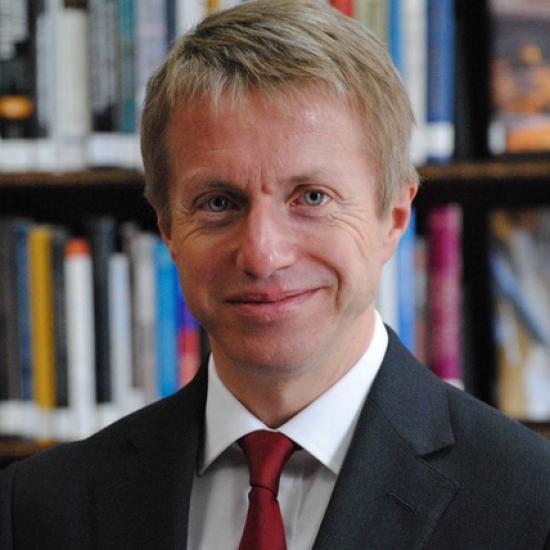
Darwin Fellow Professor John Nilsson-Wright will give this term’s Erasmus Seminar, on Wednesday 4th February.
John Nilsson-Wright is the Fuji Bank University Professor of Modern Japanese Politics and the International Relations of East Asia in the Faculty of Asian and Middle Eastern Studies. He is also is Head of the Japan and Koreas Programme at the Centre for Geopolitics, POLIS.
In addition to his positions at Cambridge, John has also been Senior Research Fellow for Northeast Asia and Korea Foundation Fellow at the Asia Programme at Chatham House which he previously directed as Head of Programme from March 2014 to October 2016.
He comments regularly for the global media on the international relations of East Asia, and has testified to the House of Commons, Foreign Affairs Committee and the House of Commons, Defence Committee.
He is a member of the editorial board of Global Asia, and is a founding member of the European Japan Advanced Research Network (EJARN). He is also a non-residential fellow at the Sejong Institute, Seoul, South Korea; a visiting senior fellow at the Korea Centre, East Asia Institute, National University of Singapore; and a non-resident fellow at the European Centre for North Korean Studies, University of Vienna.
Romantic Revolutionaries: Populism in East Asia and its consequences
In recent years populism has become a critical phenomenon shaping not only domestic politics but also foreign policy in Europe and North America, contributing to a new pattern of authoritarian politics that is threatening the integrity of democratic states.
Brexit and Donald Trump’s election as president in 2016 challenged long-held norms of rationality, stability and predictability that underpinned mainstream politics and international relations theory. These norms have increasingly been replaced by analytical methods that focus on emotion, anger and political marginalisation in shaping political behaviour.
For many years, and particularly since the 1990s, South Korea and Japan were often viewed as states that were relatively immune to this populist contagion and seemingly stable models of political legitimacy. However, taking a longer historical perspective reveals that politics in Japan and South Korea has long been sharply contested and that similar patterns of political alienation, contested political identity and an unrealised desire for political agency found in Europe and North America also apply in East Asia.
John’s talk will examine the roots of this emotionally driven political process in both countries and considers why political contestation may have significant consequences for the geopolitics of northeast Asia.