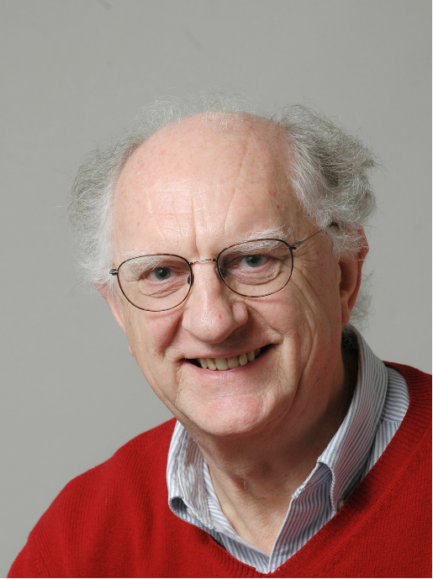
Darwin alumnus Professor John Clarke was announced today as the recipient of the 2025 Nobel Prize in Physics, an honour which he shares with Michel H. Devoret and John M. Martinis, in recognition of their work revealing quantum physics in action.
The Master, Dr Mike Rands, said:
“We are delighted and deeply proud to see our early alumnus and Honorary Fellow, Professor John Clarke FRS, awarded the 2025 Nobel Prize for Physics in recognition of his groundbreaking research in quantum mechanics. Typically, John described this accolade as ‘the surprise of my life’ but those of us who have been lucky enough to know him recognise it is richly deserved and recognition of his science, integrity and brilliant mind.”
John joined Darwin in 1965 as part of the College’s earliest cohort of PhD students, following his undergraduate studies at Christ’s. Born in Cambridge in 1942, he attended the Perse School on an academic scholarship.
His PhD research was focused on the Josephson Effect, which had been established by Brian Josephson several years earlier, and for which he won the Nobel Prize in 1973. While at Darwin he developed the SLUG (Superconducting Low- inductance Undulatory Galvanometer) and the SQUID (Superconducting Quantum Interference Device), the basis for the past half-century of research.
“During my career I’ve developed many different applications involving SQUIDs,” he said in an interview with Darwin last year.
“I’ve worked on geophysics, developing a new technique to look for minerals under the surface of the ground by pulsing the ground with a large magnetic field. I became very involved in astrophysics projects because it turns out we could make very sensitive devices for looking at stars. I was also involved in medical physics and ultralow field magnetic resonance imaging. Two members of my group, John Martinis and Michel Devoret, and I showed that under appropriate conditions macroscopic circuits obey quantum mechanics. One of my current projects, with many colleagues, is searching for the axion, a candidate particle for cold dark matter. Something I’ve always been really happy about is the fact that I could take the basic idea of the SQUID and apply it to very many fields.”
John took up a research position in 1968 at the University of California at Berkeley, becoming Professor of Physics and, latterly, Professor Emeritus of the Graduate School. However he maintains close ties to Cambridge, accepting a role as Honorary Fellow at Darwin in 2023.
Last year, on the College’s 60th anniversary, he recalled the experience of being one of the first Darwinians.
“At the time, I have a feeling there were more Fellows than research students. So we would enjoy our excellent dinner and wine and chat about all kinds of different things. It was a wonderful experience talking to these somewhat older, more knowledgeable people about your life in general and research in particular. Darwin had a huge impact on my life.”

John Clarke (back row, fourth from right) and his Fellow Darwinians, 1966