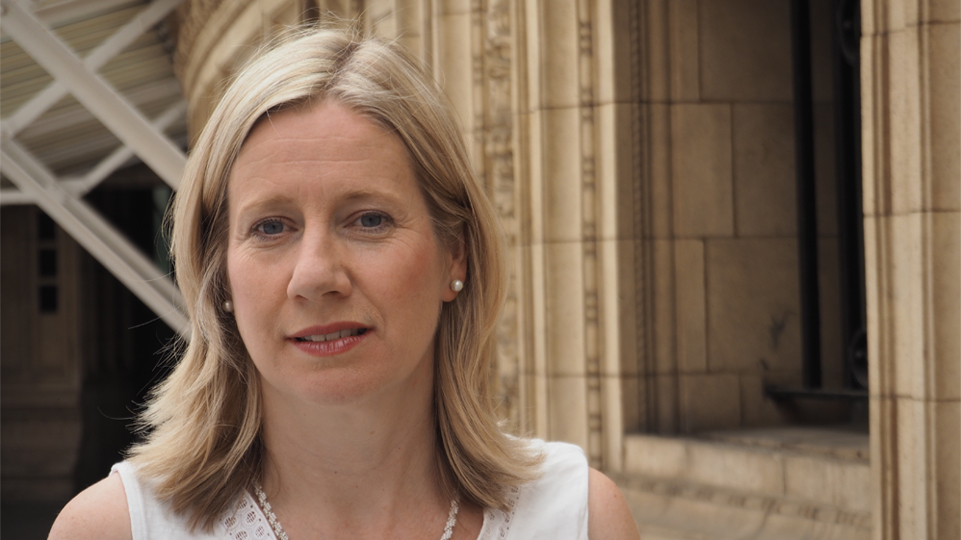
When Carola Darwin delivers her Darwin College Lecture, she won’t just be sharing the fruits of her research into female musicians in early 20th century Vienna. She will also bring their music to life, bringing together the strands of her dual career as a historian of music, and an opera singer.
Combining the roles of lecturer and performer in one event is “actually quite tiring”, she discovered after a run through to friends.
“Singing four songs doesn’t feel like a big deal, and talking for three quarters of an hour doesn’t feel like a big deal…but switching mentally and vocally from talking to singing and back again is quite demanding.”
Carola’s academic career began at Cambridge in an unrelated field, with an undergraduate degree in Natural Sciences.
“It was extremely hard work,” she admits. “I went to a school that was very very keen on women doing science, and I did and still do find it absolutely fascinating. But I spent quite a lot of time going ‘I know I should be working, but actually there’s this choir I want to sing in, and I’m just going to do that.’ I just found that, whenever there was a choice, I was doing music.”
After graduating, she completed a Master’s in singing at the Royal Northern College of Music, before embarking on a performance career. But confronted with the competition of life as a professional soprano, and missing academia, she expanded her options by beginning a PhD at Sheffield University, exploring gender representation in opera in the 1900s.
“One of the reasons I picked Sheffield was because they would let me do a performance as part of my submission, which is now quite standard, but at the time there were only three or four places in the country where you could do that. I think another way that I was very lucky was that I happened to start my PhD just as the academic music world started saying – you know what, it isn’t just about composers. Performers do something important, so perhaps we want to talk about the whole idea of performance practice and not just look at scores but also look at other ways of looking at music.”
Despite her assumption that, having completed her PhD, she would be firmly drawn to a career either in music or in academia, Carola found herself more reluctant than ever to give up either element. Instead, she accepted a role at the Royal College of Music, where she is now a doctoral supervisor and Professor of Academic Programmes, and has carved out a bespoke combination of research, teaching and performance.
“From the point when I went ‘I need to go to music college if I can’, I was following my heart,” she explains. “And my heart kept pulling me in both directions. So I had to find a way to make it work.”
The RCM is somewhat more understanding when performance schedules clash with teaching commitments than other employers might be. But for the past decade there’s been a further element in the mix, after Carola was approached by BBC Radio 3 to share some research on a female composer. She contributed her work on Johanna Müller-Hermann, which became part of the station’s project Five Women Composers, and went on to present part of the Composer of the Week programming focused on Müller-Hermann in 2023. She now runs a postgraduate course on women in music, and is currently completing a book, The Other Voice: Women’s Musical Creativity in Alma Mahler’s Vienna.
“It’s just such an amazing period,” Carola says of Vienna in the 1900s.
“There’s so much going on. There’s amazing music, but also art, literature, philosophy, psychology, you name it. So I thought, I’d really love to look at how women contributed to that ecosystem.”
Carola’s lecture will draw on her research for the book, focusing on a number of female composers, performers, teachers and critics to explore how their lives were interwoven with the Viennese musical world of the time.
“There’s a funny thing when talking about women, that you want to say, let’s look at the fact that their lives were different and they had different challenges, but you also want to say, but they were still doing some of the same jobs. They were in the same world, and in a way that was part of the challenge, that they had to fit themselves into this world that wasn’t terribly well suited to them.”
By lending her voice to these women, Carola hopes to demonstrate their significant role in a musical landscape from which history has all too often excluded them.
“If you’ve got a network of people in the past, imagine it as a network of little wires and lots of little bright lights. There are blue lights and pink lights, and history has really really often turned off the pink lights. So what I want to do is two things. First of all, I want to just turn off the blue lights so that we can see the pink ones. And then I want to turn on both sets of lights, once you’ve got used to the idea that the pink lights are there. I basically want to say, when you look for the women, you find them.”
Join us for Carola’s lecture, Hearing Her Voice: Women Musicians in Vienna 1900, at 5.30pm on Friday 20th February.