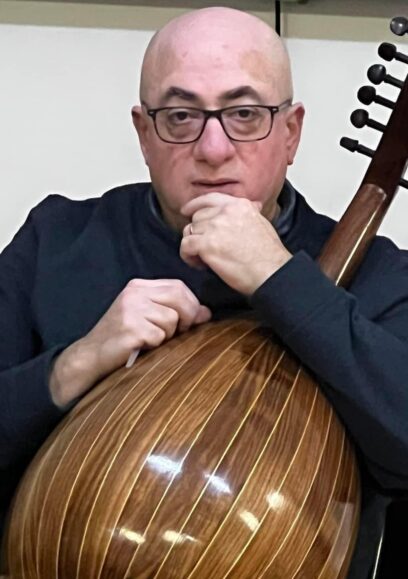
Issa Boulos is a busy man. His new album, The Dark Side of the Moon, which sets his poetry to his own compositions for voice and classical guitar, has just been released. His latest book, on the history of Palestinian music, will be published by the University of Texas next year. His “day job”, managing the Community Music and Arts Centre at Harper College in Chicago, involves overseeing hundreds of courses from fiction writing to ceramics, as well as teaching his own music courses. And, on Friday 6th March, he’ll be giving a Darwin College Lecture, Palestinian Song in Transition: The Interplay of Tradition and Innovation, 1936-1948.
The talk will explore the impact on Palestinian musical identity of the establishment of the Palestine Broadcasting Service (PBS) and the Near East Broadcasting Station (NEBS) in the 1930s and 40s.
“Music making in the context of broadcasting took on a different shape, because it was more focused, and you had clusters of musicians who really knew what they were doing. All of a sudden you have lots of different types of music, and musical communities, who were never in touch before, in one small place, having to work together. The two broadcasting stations hired people from Egypt and elsewhere, and that contributed to bringing new perspectives and elevating the level of music making within the stations.”
Issa’s research draws not only on surviving recordings, but also on printed sources which demonstrate the richness of the musical scene.
“We have periodicals and newspapers and journals and magazines with advertisements of concerts and musical activities taking place. So it’s a very exciting chapter that sheds light on how Palestinians navigated modernity and identity during the first half of the 20th century.”
For Issa, the fascination of the period is personal.
“My father as a young man was very active in the music scene, along with my uncles. We have evidence that music making started to take on a more industrialised shape as early as the first decade of the 20th century. So we have commercial recordings coming out of the region, and a lot of the things that they were doing ended up becoming genres in the region.”
The lecture will combine an overview of the musical history of the period with recordings and live performance.
“I think any time we talk about music you really have to play something just to get people to hear it. These recordings are really difficult to find, but I’ve been working with an organisation that I co-founded in Ramallah back in the year 2000. It’s still going, and we managed to lay our hands on some really interesting recordings.”
Fortunately for the Darwin audience, Issa has managed to source an ‘ūd (or oud) for his Cambridge performance, as the traditional stringed instrument is a awkward travel companion.
“I have to buy a seat for the instrument, and even when you buy a seat, the way it goes through customs…they treat it like a sack of potatoes, you know? They just throw it.”
Issa began playing and singing as a small child, performing at school and in neighbourhood recitals, before expanding his reach to venues across the West Bank. As an adult he recorded with numerous groups as well as as a solo artist, before pursuing Bachelor’s and Master’s degrees in Music Composition in the United States, and a PhD in Ethnomusicology at Leiden University.
“I always ask questions,” he says of his interest in music from an academic perspective.
“I asked questions when my mum taught me a song, and then obviously I started asking more serious questions over the years. And then I started writing about it and documenting those conversations and encounters that I have with musicians. So my ethnomusicological mind was there from day one.”
This mindset has shaped both strands of his career.
“I have this passion for composing music, writing songs and poetry, but also having some contextualisation that comes with whatever I do. Because I’m a storyteller. I never look at music as just something that appears in concert halls or in practice rooms in the basement. It’s something more organic and more alive.”
Drawing out the untold stories of Palestinian music making also enables him to pay tribute to his people.
“Obviously there are plenty of scholarly works about how national identity emerged and all that. I have my own take on these things from the perspective of music making, because music can offer you something unique that nationalist ideology doesn’t. But one of the most important things that I want to leave the audience with is that Palestine during that period was second to Egypt in musical production and innovation and creativity. And they basically created the foundation for various other genres that followed in Lebanon, Syria and even Iraq and Jordan. So I just want to bring some awareness to the contributions of Palestinians during the first half of the 20th century to the artistic endeavours that emerged from the region thereafter.”
Join us for Issa’s lecture, Palestinian Song in Transition: The Interplay of Tradition and Innovation, 1936-1948, at 5.30pm on Friday 6th March.