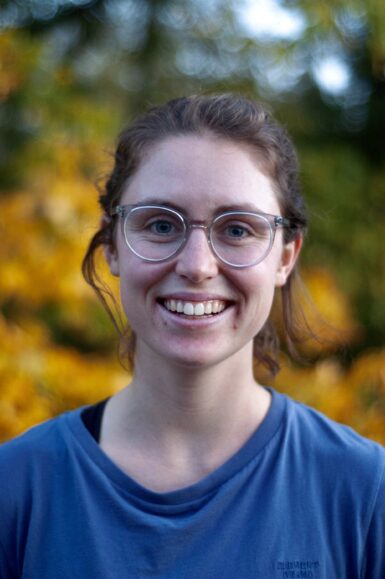
Bronte Evans Rayward turned her academic life upside down in more ways than one when she moved from Australia to Cambridge. Having studied visual art and history as an undergraduate at the Australian National University, she completed an MPhil in Polar Studies, before proceeding to a PhD in Geography, exploring “stories about the environment told by human communities in island places.”
She credits her lifelong interest in the environment with growing up in the biodiverse context of rural Australia. But her passion for polar studies has its roots in her undergraduate studies, which involved both a 20,000 word thesis on the history of Antarctic expeditions, and putting together an art exhibition inspired by the history of whaling.
“I made a whole load of etchings from photographs that had been taken on a whaling expedition to Antarctica in the 1920s. There were these beautiful photographs – amazing, but incredibly gory. But they were such evocative images, and it was an industry and culture that I just found really interesting.”
This fascination drove her application to the MPhil in Polar Studies in the Department of Geography, which she completed at Robinson College.
“It was amazing to be in the Geography department because it’s such a welcoming discipline in terms of managing lots of different subjects. It meant I could read quite widely and think about how a variety of literatures and research methods could be brought together to inform my thinking about environmental humanities for the PhD.”
Bronte’s PhD research explored environmental narratives in the Falkland Islands, looking at how they shape a sense of connection and identity, as well as how they inform environmental decision making.
“There are quite diverse ways of valuing the environment in the islands, depending on who you talk to and what their background is,” she explains. “I was picking up on some of those tensions and then thinking about how narratives can inform environmental preservation in a way that is locally driven and likely to have longevity and be supported by the community.”
Having transferred from Robinson to Darwin for her PhD, Bronte admits that the value of the collegiate community, alongside the relationships she was building through the department, wasn’t instantly apparent.
“I took a while to realise what an amazing opportunity it is to be here, because I was kind of caught up in my department and my work. But a friend from my department introduced me to a few more people and it made such a difference. There was a group of us who would go for coffee quite regularly, all from completely different disciplines, and it was fascinating to be exposed to. It’s such a wonderful environment, such a lovely culture, and a very reassuring space. The whole informal support structure that exists – it definitely felt like home in a way that I hadn’t anticipated when I applied.”
Since completing her PhD last year, Bronte has spent time as a postdoctoral researcher at the Scott Polar Institute and is now weighing up her options. Between academia and the wider world; staying in the UK or heading back to Australia, the possibilities have expanded to a global scale. But as she celebrates her graduation this weekend, we’re proud to be her UK home.