
If Darwin doesn’t quite claim to be a utopia, we certainly spend a lot of time telling ourselves and the rest of the world what makes this particular way of organising life, learning and community so special.
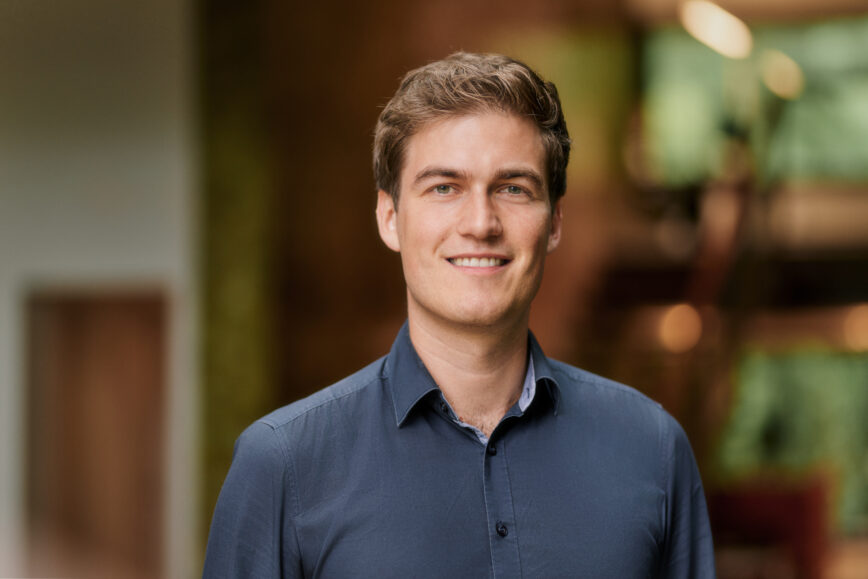
Jonas Spengler, who graduates this weekend with a PhD in Organisation Theory, is better placed than most of our graduating students to judge. His research involves immersing himself within groups and communities, with a particular interest in the concept of utopias and how people attempt to achieve them.
“Utopias are not something which is possible or impossible,” he clarifies. “It’s just something that’s there – people have mental models of what they think a good organisation should be. The interesting bit is how that then informs what people actually do.”
The breadth of his undergraduate Liberal Arts degree at University College Maastricht gave him unusual space to consider where his interests lay.
For Jonas, this turned out to be a fascination with organisations, and how people come together to achieve something. In his first immersive project, he signed up to volunteer at a refugee camp in Calais, studying the motivations and approaches of his fellow volunteers. Despite being open with his colleagues from the beginning about his academic interest in their work, the duality of his role was not lost on him.
“I was cutting onions or distributing clothes alongside these people, and always scribbling notes on the side. It’s always weird to not really be one of them, because even if you’re doing the same job, and even if you’re from the same demographic, which I was, you’re still never going to be them because you always have this other project in the back of your mind.”
The project expanded to form part of his PhD, alongside further fieldwork with a Mennonite community in Paraguay, established as a self-sustaining ‘colony’ living by a literal interpretation of the Bible; as well as an NGO established by the Mennonites to support Indigenous communities out of poverty.
“I think we live in a time when it’s really important to understand other people’s view of the world, particularly when it doesn’t fit with your own, necessarily. So I was very transparent from the beginning and said ‘look, I’m here to understand how your system works and why it makes sense to you, and share that experience with the world.’ It has to be a fair portrayal.”
Jonas’s research sits within the field of Organisation Theory, a categorisation which he sometimes finds himself defending.
“Organisation Theory is already a bit of a broad umbrella. We have people from many different backgrounds – psychologists, sociologists, economists…but even within that umbrella my research is a bit colourful. The origins of this field were to understand how to organise factories better, so I always need to justify how what I study is ultimately valuable for companies.”
At the Judge Business School, however, his interest in communities beyond the factory floor was not unusual.
“The Judge has a reputation for being extremely qualitative in its research approach, which I really wanted. And they just do a lot of quirkier contexts. They don’t restrict what they study to for-profit businesses only.”
At Darwin, utopia or not, the multidisciplinary atmosphere was the perfect complement to Jonas’s research.
“My girlfriend is a chemist, I have friends who did AI research, I have other friends who are in economics, I have other friends who are ecologists. You just learn so many different ways of thinking.”
Jonas graduates this weekend with a PhD in Organisation Theory. He has recently been appointed to an Assistant Professorship at Università della Svizzera Italiana in Lugano, Switzerland.
