
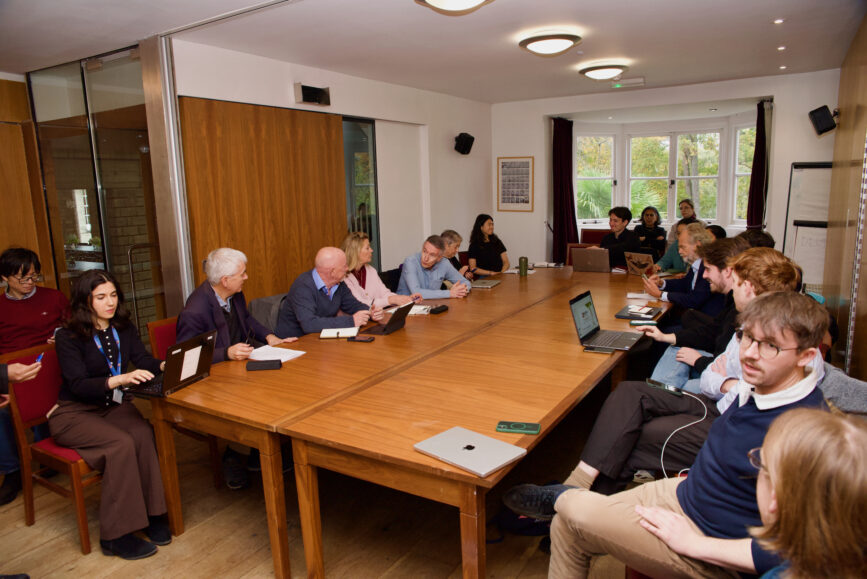
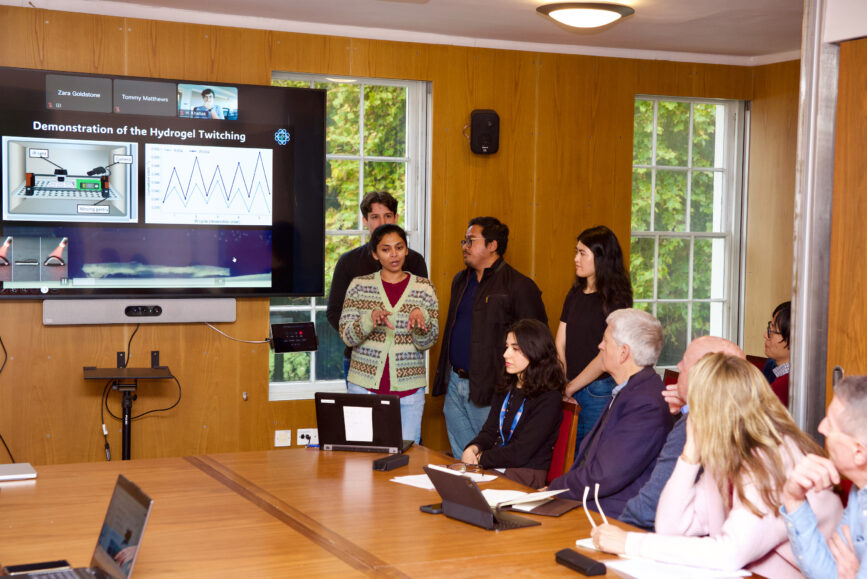
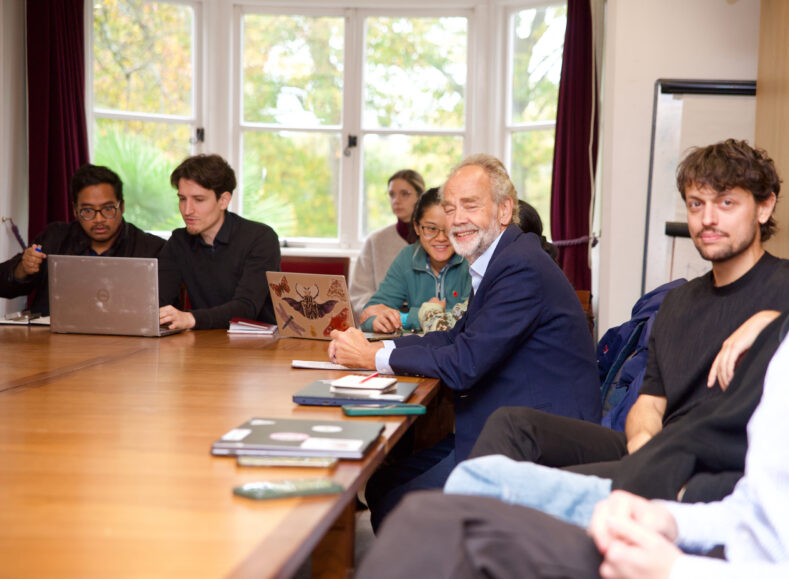
The recipients of Darwin’s first round of Small Grants for Big Ideas, launched earlier this year, came together last Thursday to describe the impact of the funding. The programme, part of the College’s response to global challenges, awards grants of up to £25,000 to three teams per year to support them in developing a concept. Teams are encouraged to bring together students, Fellows and alumni, ideally working across disciplinary lines.
One team, RedRoot, is working to improve trust in sustainable agriculture by measuring the impact of arbuscular mycorrhizal fungi (AMF), which colonise plant roots and trade phosphate for plant sugars, reducing the need for synthetic fertilisers.
“Supported by the Darwin Small Grants for Big Ideas, our RedRoot team has built and field-tested the first scalable, functional readout of mycorrhizal activity. With backgrounds spanning plant science, molecular biology and bioinformatics, this grant really enabled us to take our research out of the lab and directly into the hands of agricultural stakeholders,” explains Matthew Mcleod, Darwin PhD student in Plant Sciences.
“Over the past four months we have worked with several UK farms, sampling a diverse set of fields and engaging with the farming community to understand the challenges they have faced this year. From that soil set, we built and optimised an analysis pipeline to quantify symbiotic activity, integrated on-farm management and fungal genomic data to pinpoint the key drivers of this symbiosis, and even uncovered an unexpected additional symbiotic partner currently almost absent from the agricultural conversation.
We are now building beyond this project, looking at wider farmer and industry collaborations, so stay tuned for what’s next!”
Meanwhile HydroStar is working to reduce infection in chronic wounds through the development of a specialist hydrogel.
“We optimised a PEG based hydrogel which was able to respond to light and change its curvature, while improving the formulation to enhance biocompatibility,” says Lakshmi Balasubramaniam, postdoctoral Fellow in Engineering Biology.
“Using the data generated through this Darwin Grant, we aim to publish the first set of results. In the next phase we will live image wound healing on an actuated substrate and assess the role of curvature in improving wound healing. We are aiming to commercialise the technique and engaging with Cambridge Enterprise and EnterpriseTECH.”
The third group, EntoUAV, responds to a gap in monitoring declining insect numbers, by developing a means of reinstating ‘the vertical dimension’. Insect populations are dispersed at altitude and, while attempts have been made to measure these using helium ballons, these methods are laborious and expensive.
“The EntoUAV project addresses this instrument gap,” the team reported.
“We developed and field-tested the EntoUAV, a drone-based insect collection platform designed to make aerial insect collection cheap, safe and flexible. The EntoUAV team is working to complete identification and morphological measurement of all collected specimens. We hope to output two papers: one covering the validation of WSR entomology described above, and another on the natural history of thrips dispersal using storm inflow and potential ice-nucleation capacity of these insects, following experimental tests of ice nucleation capacity of thrips in collaboration with Ben Murray at the University of Leeds.
We have submitted a follow-on proposal to the UKRI grant call Advancing Atmospheric and Aerial Autonomy. The project, ‘WISP: the Windborne Insect Sampling Platform for automated aerial entomology’, proposes to build a fully autonomous aerial insect sampling device building on EntoUAV. The long-term vision of WISP is to deploy a network of ‘virtual masts’ across the UK collecting a standardised entomological and genetic samples in three dimensions to high altitude, alongside radar and suction-trap networks.”
Former Master Dr Mike Rands, who initiated the programme and attended last week’s event, was impressed by the rapid progress.
“The fact that all three projects produced tangible and innovative outcomes was remarkable and, even more impressively, they have all applied for follow up funding at scale,” he said.
“Three of the student members said to me afterwards that they found being part of a multidisciplinary group and working on something that was not their main research project but a topic that could become practically impactful had made them think there was more to their career prospects than straight academia. I thought that was extremely encouraging too.”
