River Source Heat

Exploring the potential for water source heat pumps

In 2021, Darwin College commissioned an estate-wide review of the buildings and their heating systems. A working group of College members was subsequently tasked with developing an ambitious but achievable plan to decarbonise the entire built estate over the next decade. It examined the scope for fabric improvements to reduce energy demand and the various options for renewable heat: air source heat pumps, ground source heat pumps, direct electric heating powered by on-site PV generation, and a closed heat network fed from a water source heat pump using the river Cam as a heat source. In 2022, in a collaboration with six other riverside Colleges, Mott MacDonald were commissioned to monitor water flow, depth and temperature at four locations on the river and to produce a detailed hydrology study. The report, delivered in 2023, confirmed the considerable potential of the river to supply heat for space and hot water heating for the adjacent Colleges.

A summary of Darwin’s work towards harnessing the river for heating purposes is available here. The report laid the foundation for the development of a future river-source heat pump.

The Pump House

Designed by 5th Studio Architects, a Pump House is being created next to the river, housing the technology needed to provide low-carbon source heating and hot water for the Silver Street estate.

A network of pipes will distribute heat to individual buildings. While this is the first river-source heat pump at this scale planned for central Cambridge, the use of the technology is becoming more common elsewhere on sites adjacent to rivers or lakes. In keeping with the College’s wider commitment to sustainability, this approach reflects our desire to be at the forefront of evolving techniques, while reducing our impact on our environment.

The Pump House will accommodate the necessary equipment, including heat pumps, circulation pumps, filtration equipment, thermal stores, expansion equipment and ancillaries to form a fully operational central heating system.

5th Studio’s design promises to create a sympathetic addition to the College site, which celebrates its innovation, raises the profile of sustainable solutions, and complements the existing industrial heritage, from Newnham Mill to the Malting House.

For more information about and updates on the building works related to this project, please visit the project progress website.
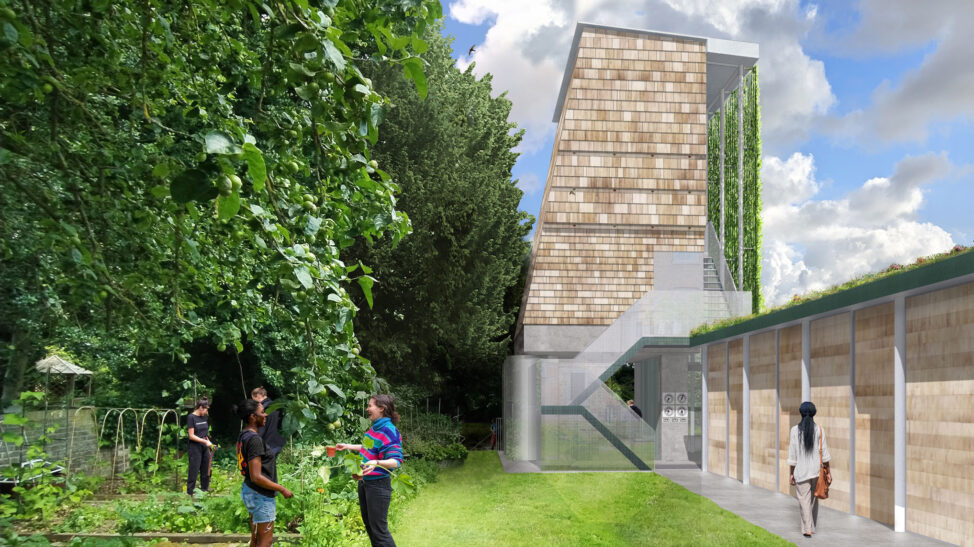
The Pump House, as viewed from the College gardens

↑ Top of the page

Upgrading our buildings for the 21st century

A switch to sustainable energy sources is only feasible if the existing building fabric is first improved to limit heat loss as much as possible.

5th Studio will therefore oversee fabric improvements to Newnham Grange and Newnham Terrace, while Caruso St John will undertake similar measures in the Hermitage, Rayne Building and Dining Hall, to support the decarbonisation of the site. These measures principally comprise improved glazing and insulation, sensitively incorporated in the the historic fabric.

Refurbishment will be carried out alongisde the thermal performance improvement works. For the central buildings, this will be the first comprehensive refurbishment in over 50 years. The existing kitchens, dating from the same time, have reached the end of their working life and will be replaced to both reduce energy consumption and increase capacity.

Frank Young House reopened its doors in 2024, newly refurbished with air-source heat pumps and double glazing.

↑ Top of the page

The Garden Room

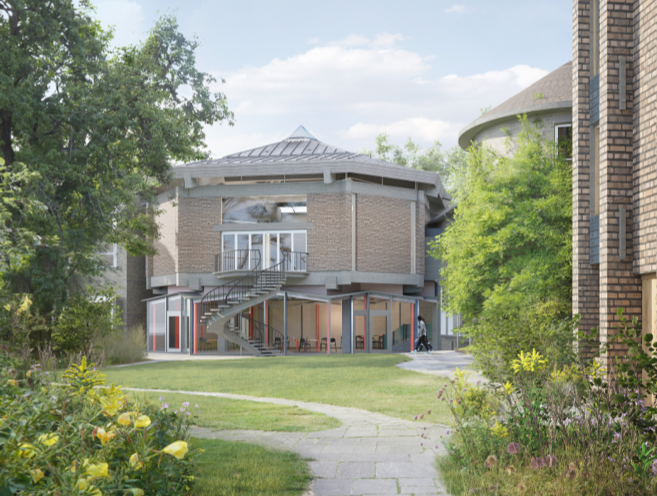
In a second phase of the project, the College has commissioned Caruso St John to design a new social space beneath the existing Dining Hall.

Lightly enclosed, to take full advnatage of its views of the grounds, the Garden Room will naturally extend the ground floor of the College, creating a seamless relationships between Newnham Grange, the Rayne Building and the Hermitage, as reflected one floor up.

The room will enable College memebrs to meet and engage with one another in a casual, light-filled setting which enjoys the surrounding aspect of the gardens, while also closing off a space which currently opens irectly onto the road, providing a sense of compeltion to the existing site. The aim is to extend the range and improve the quality of social spaces int he College for events, informal study, and collaboration.

View towards the Garden Room from the gardens

↑ Top of the page

Energy Sources and Demand Reduction

Renewable Energy of Origins (REGOs) Contract

The College is already supplied with renewable electricity through the College consortium for electricity. The Renewable Energy of Origins (REGOs) contract is valid until 2027 for the main site, guaranteeing 100% UK-generated renewable electricity.

University of Cambridge student Green Officers visiting one of the solar farms contained within the Cambridge Colleges Renewable Energy of Origins (REGO) contract.

Smart thermostatic radiator valves

In 2023, the College conducted an energy management trial with Ecosync, installing smart thermostatic radiator valves (TRVs) in student houses, Newnham Terrace 3 and 10, for dynamic energy management and temperature control on a room-by-room basis.

Building on this trial, additional TRVs were installed in 2024, particularly in seminar rooms, which tend to have lower heating demand during peak hours compared to residential buildings. The valves are equipped with small fans that help distribute heat more evenly, allowing radiators to operate at lower temperatures while maintaining comfort levels. Both the fans and the heat sensors can be dynamically adjusted.

↑ Top of the page