Sustainable Catering

Promoting plant-based, low-carbon diets

Notably, at Formal Halls, the default meal option is vegetarian, unlike at most other Cambridge colleges. Meat and fish remain available, but attract a small surcharge to reflect their higher financial and environmental costs. This flipping of the standard default retains personal choice, while significantly reducing the overall consumption of meat, as around half of Darwinians typically stick with the vegetarian default.

The College takes a similar approach to daily food service: vegan and vegetarian options are subsidised more generously and placed first in the servery, and catering at College events is also vegetarian by default.

CamEATS ZERO

Darwin Fellow and Director of Cambridge Zero, Professor Emily Shuckburgh, and College Catering Manager, Ivan Higney, took to the stage in February 2023 to launch CamEATS ZERO, a new initiative focused on supporting Cambridge Colleges to implement sustainable food policies. As a member of the CamEATS ZERO Steering Group, Ivan has also led the development of a Catering Staff Training Programme for plant-based cookery and minimising food waste.

Sustainable and ethical catering statement

This statement sets out the College’s intentions to minimise the impact of its catering operations on the environment, and its approach to promote sustainable and ethical practices and consumption. The latest Sustainable and Ethical Statement was agreed in 2020 and sets out the following:

Summary of Aims

  • Reduce ruminant meat.
  • Reduce the consumption of dairy products.
  • Promote the consumption of more plant-based foods.
  • Reduce food wastage.
  • Source food and other products locally where possible.
  • Ensure that products are traded fairly throughout the supply chain.
  • Ensure that we provide fish from sustainable sources, limiting the impact on threatened stocks and through the environmental impacts of aquaculture.
  • Reduce single use plastic and reduce the use of all plastic packaging.
  • Continue to implement forward-thinking sustainability best practice.

Objectives

  • Raise awareness of the benefits to the environment and individuals of the sustainable and ethical statement through communications, training and accreditation applications.
  • Monitor performance against the statement aims, including setting sustainable food targets, and reporting regularly on performance against these.
↑ Top of the page

Sustainable food initiatives

Community fridge

Established in 2021 in collaboration with the DCSA, the Darwin Community Fridge allows the catering team to share servings of food left over after each meal. The food is free for all Darwin members to take and is allergen-labelled, helping to minimise the kitchen’s food waste while fostering a culture of sustainability and community care.

The Community Fridge won the University of Cambridge Green Impact Community Award.

Student Garden

Darwin has a very active garden society, DarGar, run entirely by student volunteers. The garden contains a wide variety of seasonal fruits and vegetables, and is so productive that its harvest is regularly used in meals prepared by the catering team and enjoyed by the whole college community. It also offers members of the college a great opportunity to learn about what can be grown in the UK climate.


↑ Top of the page

Waste management

The College recognises its responsibility not only for the waste it produces, but also for the behaviour of its members. We aim to promote best practice in waste reduction and responsible waste disposal.

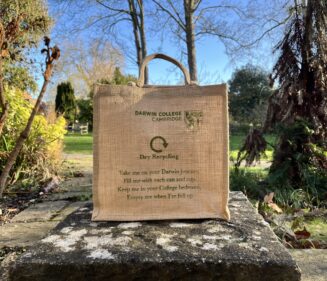
The College Catering Department has been a leader in this area, having segregated food, recyclable and non-recyclable waste for several years, as well as taking the decision to remove single-use takeaway cups and containers, encouraging the use of reusable alternatives.

In May 2025, the College implemented four separate waste streams in line with new UK government regulations:

  1. Recyclable waste – This includes clean hard plastics, cardboard, cans, and paper. Soft plastics, such as crisp packets or coffee cups, should not be put in this bin.
  2. Glass – For all glass bottles and jars.
  3. Food waste – For all food scraps and tea bags, but not for compostable packaging.
  4. Non-recyclable waste – This includes items that cannot be recycled, such as used tissues and paper towels, plastic bags, black bin bags, and food contaminated containers.

To support responsible waste management, bin signage was also updated to include consistent colour coding and clear labels. Darwin College also weighs its waste to monitor disposal habits, track progress, and to ensure that the College stays both sustainable and compliant.

Efforts have also focused on fostering good waste practices within College accommodation, with the Housekeeping Team ensuring that students have up-to-date and clear guidance while living in College. These sustainable habits can then be carried forward beyond Cambridge.

↑ Top of the page

Related Sections